
About Our Repeaters
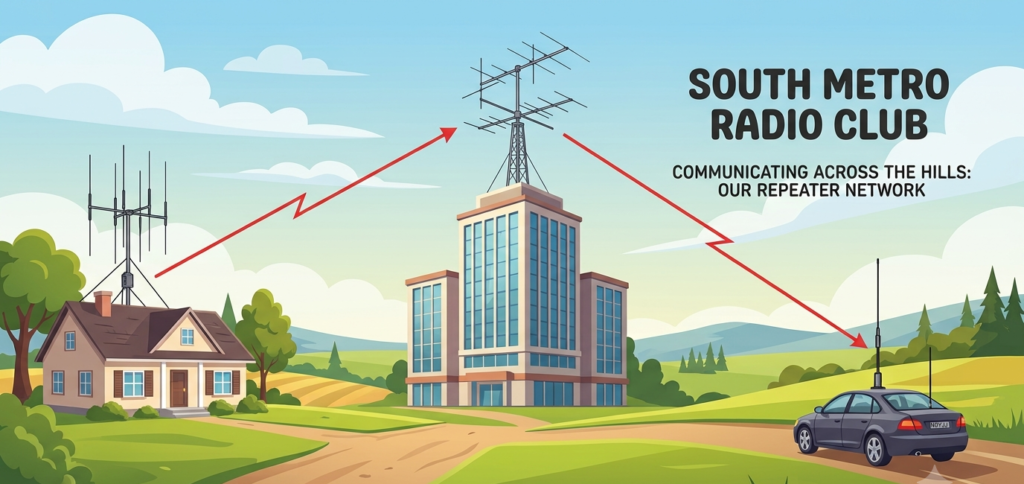
Welcome to the heart of our club’s communication network! Our repeaters are the towering sentinels that connect our radio community, stretching our signals across the Minneapolis / St Paul area valleys and hills, and worldwide via EchoLink and Allstar networks, to ensure no one is out of reach. Whether you’re a seasoned ham radio operator with a powerful base station, or a newcomer with a low cost walkie-talkie, these machines are here for you—to help you make a contact, pass along vital information, or just share a friendly chat with a neighbor. Signal Reports Always Welcomed
This page is your guide to accessing these vital resources. Explore the frequencies, locations, and tones below, and get ready to key up and connect!
Quick Links | Farmington GMRS repeater | Lakeville GMRS Repeater | Rosemount GMRS Repeater | Prior Lake GMRS Repeater | Farmington 6m repeater | 11m/CB |
GMRS Repeater (Farmington, MN)
Welcome to our primary GMRS gathering spot! We have designated our repeater on GMRS Channel 18 as our club’s main hangout and a monitored emergency resource. This frequency is our digital campfire, a place for our members to check in, coordinate events, offer assistance, and enjoy casual conversation. Signal Reports Welcomed
Key Details:
- Output Frequency (You listen on this): 462.6250 MHz – Commonly referred to as Channel 18
- Input Frequency (YOU transmit your signal on this): 467.6250 MHz
- CTCSS Tone (Required): [CTCSS Tone: 100.00 Hz]
- Status: [Online / Active] – Our repeater is up and running 24/7 to serve the community.
- Open/Closed System: This is an open system, available for all licensed operators to use
Repeater Location / Details
- Location: The repeater is located near 175th St and Flagstaff Ave in Farmington, MN.
- Antenna Height): About 60 feet to the tip of the Antenna
- Power Output: The repeater is transmitting at maximum legal power of 50 watt, resulting in about 46 watts to the antenna after the duplexer
- Antenna: Comet GP9 NC (9db gain)
- Feedline: Low loss hardline
- Repeater: Hytera 982i
- Power Output: 50 watts
- Technical Effective Radiated Power (ERP) : Estimated 160 watts. Repeater output, plus antenna gain, minus duplexer loss, and feedline loss
If you are new to GMRS, remember, you must set the “Transmit Tone” (or CTCSS Tone) to 100.00 Hz on your radio. Setting this on receive is optional, but highly recommended.
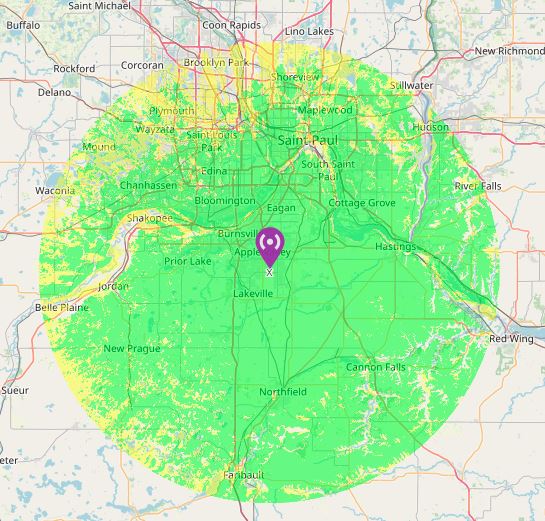
Repeater Coverage Maps
Estimated coverage to a mobile using a 3 db gain antenna
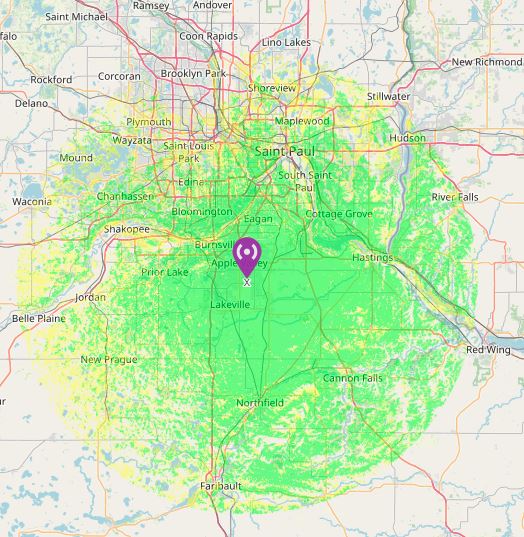
Estimated coverage to a base station with a 3 db gain antenna on roof at 30 feet.
Signal Reports Wanted!

Let’s us know “on the air”, or make your report via our Contact Page
Remember: A valid FCC GMRS Radio license is required to transmit on this repeater
Quick Links | Farmington GMRS repeater | Lakeville GMRS Repeater | Rosemount GMRS Repeater | Prior Lake GMRS Repeater | Farmington 6m repeater | 11m/CB |
GMRS Repeater (Lakeville, MN)
Welcome to the south metro’s second GMRS repeater. The Lakeville, MN repeater is not too far from the Farmington repeater in location, and many of us can be found on either one of the two excellent repeater systems. This repeater has has excellent coverage too, but just slightly less than the Farmington repeater. Signal Reports Welcomed
Key Details:
- Output Frequency (You listen on this): 462.7000 MHz – Commonly referred to as Channel 21
- Input Frequency (You transmit your signal ): 467.7000 MHz
- CTCSS Tone (Required): [CTCSS Tone: 141.30 Hz]
- Status: [Online / Active] – Our repeater is up and running 24/7 to serve the community.
- Open/Closed System: This is an open system, available for all licensed operators to use
Repeater Location / Details
- Location: The repeater is located near 170th St and Flagstaff Ave in Farmington, MN.
- Antenna Height: About 45 feet to the tip of the Antenna
- Site Elevation: 988
- Power Output: The repeater is transmitting at 50 watts
- Technical Effective Radiated Power (ERP) : Estimated at 160 watts. Repeater output, plus antenna gain, minus duplexer loss, and feedline loss
- Antenna: Comet CA712EFC (10 foot 5 inch length, and 9db gain)
- Feedline: 100′ of Helilax 1/2
- Repeater make: Motorola
Remember: A valid FCC GMRS Radio license is required to transmit on this repeater
If you are new to GMRS, remember, you must set the “Transmit Tone” (or CTCSS Tone) to 141.3 Hz on your radio. Setting this on receive is optional, but highly recommended.
Quick Links | Farmington GMRS repeater | Lakeville GMRS Repeater | Rosemount GMRS Repeater | Prior Lake GMRS Repeater | Farmington 6m repeater | 11m/CB |
GMRS Repeater (Rosemount, MN)
This repeater has a solid 10 mile range, and serves Rosemount, Apple Valley, Eagan, east towards Hastings, south towards Farmington, and the southern part of Inver Grove Heights, MN well. The Rosemount repeater system is engineered for maximum reliability across all seasons. Utilizing a professional-grade 50W Vertex platform and a PcTel (Maxrad) 3 dBd gain antenna. Signal Reports Welcomed
Key Details:
- Output Frequency (You listen on this): 462.575 MHz – Commonly referred to as Channel 16
- Input Frequency (You Transmit here): 467.575 MHz
- CTCSS Tone Required: [CTCSS Tone: 141.3 Hz]
- Status: [Online / Active] – Our repeater is up and running 24/7 to serve the community.
- Open/Closed System: This is an open system, available for all licensed operators to use
Repeater Location / Details
- Location: The repeater is located near Bacardi Ave and Bonaire Ave in Rosemount, MN.
- Call Sign: WRPU609
- Site Elevation: AMSL 965 feet
- Antenna Height: 38 feet to the tip of the antenna
- Power Output: 50 watt
- Antenna: PCTel (formerly Maxrad) MFB4603 (3 dBd gain), 30-35 degree radiation angle to get through the location tree canopy
- Feedline: LMR-400. Why not Heliax? Site is optimized for spatial constraints and site-specific flexibility.
- Repeater: Vertex VXR-7000, a legendary repeater workhorse.
- Duplexer: Sinclair MD356. 6 cavity, insertion loss max 1.4db
- Power Output: 50 watts
- Technical Effective Radiated Power (ERP) : 60 watts. Repeater output, plus antenna gain, minus duplexer loss, and feedline loss
Seasonal Performance: The repeater power is 50W output, and utilizes a high-efficiency PCTel MFB4603 3dBd omni-directional antenna to optimize signal footprint within the immediate terrain to push RF energy toward the horizon (where the users are). The 35 degree beamwidth of the antenna focuses RF energy like a lamp, shining light and bending around threes and foliage, whereas any high dB gain would antennas sound like it would work better, higher gain antennas focus RF energy like a flashlight, or laser beam, shooting out, hitting the foliage, and stopping, putting nothing out past the trees. If the antenna was well over the tree tops, say 70 feet or higher, then a higher 7- 9 db gain antenna is the correct tool.
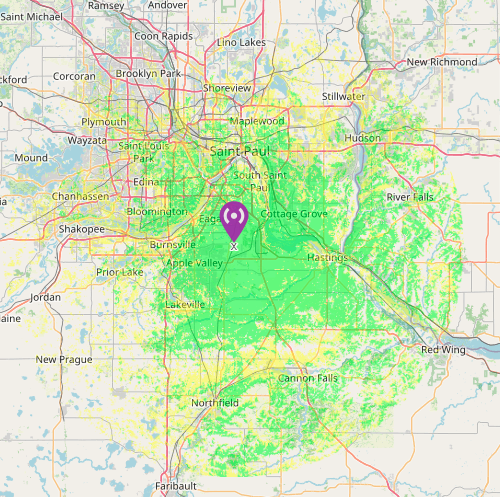
Regardless, due to 35 foot antenna height, and the antenna NOT being over the tree tops, one must consider Foliage Attenuation. At 462 MHz, the dense layer of trees at the site can easily introduce an additional 6 dB or so of attenuation, resulting in what is known as an Effective Path Wattage, or the effective power equivalent arriving at the “clear air” past the local tree cover. In this case, we calculate this resulting in more like a 25 watt ERP. This still results in a solid 10-14 mile coverage range in the summer months, with a noisy, but readable signal on the edges of the coverage area. When the leaves drop in Minnesota, the foliage attenuation loss doesn’t just disappear, it drops significantly- giving the repeater significantly better winter coverage, with more like a 50 watts ERP, and a more solid full quieting signal at the maximum range.
Speaking of maximum rage, UHF is primarily line of site. At the antenna height of 35 feet, line of site range to a mobile is about 8.37 miles, while base station antenna at 30″, the line of site jumps to about 14.67 miles. Due to this obvious height, if one day I can raise the antenna from 35″ to 50″, that would improve both base and mobile coverages another 10 miles.
We’ve done an advanced engineering analysis for this site with maximum legal power, low loss cable, and the right gain on the right beamwidth for the repeater location. Most people in the easy to put up GMRS repeater world never look at the vertical beamwidth specs, they just look at the dB number. We’re looking at the radiation pattern, which is how you actually build a repeater that works!
If you are new to GMRS, remember, you must set the “Transmit Tone” (or CTCSS Tone) to 141.3 Hz on your radio. Setting this on receive is optional, but highly recommended.
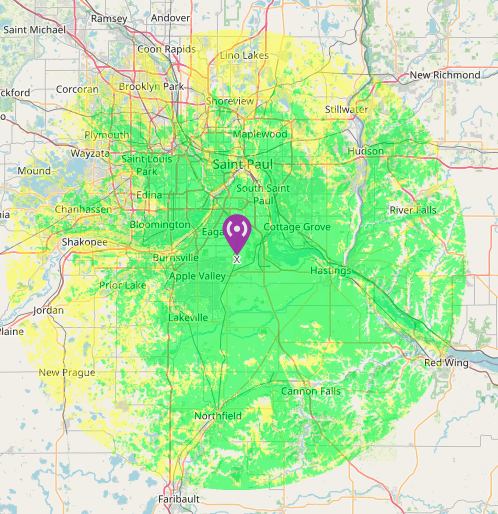
Estimated Real Life Repeater Coverage Maps
Estimated coverage to a mobile radio using a 3 db gain antenna
Estimated coverage to a base station with a 6 db gain antenna at 30 feet.
Quick Links | Farmington GMRS repeater | Lakeville GMRS Repeater | Rosemount GMRS Repeater | Prior Lake GMRS Repeater | Farmington 6m repeater | 11m/CB |
GMRS Repeater (Prior Lake, MN)
Welcome to the Southwest metro’s newest repeater. Located in Prior Lake, MN. This repeater is pretty much on top of the hill, with all downhill to the river valley to the north. Should provide excellent local Prior Lake/Shakopee coverage, and well across the river into Eden Prairie. Signal Reports Welcomed.
Key Details:
- Output Frequency (You listen on this): 462.550 MHz – Commonly referred to as Channel 15
- Input Frequency (Repeater listens for your signal on this): 467.550 MHz
- CTCSS Tone (Required): [CTCSS Tone: 146.20 Hz]
- Status: [Online / Active] – Our repeater is up and running 24/7 to serve the community.
- Open/Closed System: This is an open system, available for all licensed operators to use
Repeater Location / Details
- Location: Prior Lake, MN (Near Hwy 13 and Fish Pointe Rd)
- Repeater: Two Wouxun KG 1000’s
- Duplexer:
- Antenna Height:
- Power Output:
- Antenna:
- Feedline:
- Power Output: 50 watts
- Technical Effective Radiated Power (ERP) : ___ watts. Repeater output, plus antenna gain, minus duplexer loss, and feedline loss
- Call Sign: WSKL838
Remember: A valid FCC GMRS Radio license is required to transmit on this repeater.
If you are new to GMRS, remember, you must set the “Transmit Tone” (or CTCSS Tone”) to 146.20 Hz on your radio. Setting this on receive is optional, but highly recommended.
Quick Links | Farmington GMRS repeater | Lakeville GMRS Repeater | Rosemount GMRS Repeater | Prior Lake GMRS Repeater | Farmington 6m repeater | 11m/CB |
6 Meter Amateur Radio Repeater (The Magic Band)
[UP / Online]
Welcome to the gateway of the “Magic Band”! Our 6-meter repeater opens the door to the fascinating world of VHF sporadic-E propagation, where contacts can bounce across the country with just a few watts of power. This is where the unpredictability of radio sport meets the reliability of local communication, offering a unique challenge and incredible reward for our amateur radio members.
Whether you’re experimenting with a new antenna, waiting for that thrilling long-distance “skip” contact, or just checking in with the local crowd, this repeater is your club’s home on 6 meters. Grab your entry level Technician class, General, Advanced, Advanced, or Extra class license, tune in, and see what surprises the Magic Band has in store for you today!
This repeater is now linked to the world via Allstar and EchoLink!
We have Minnesota Repeater Council permission for the following frequency:
Key Details:
- Status: [Up/Active] – As of this update (July 29, 2026) – Our repeater is up and running 24/7 to serve the community.
- Output Frequency: (YOU listen on [53.210 Mhz]
- Input Frequency (Offset): Negative – 1.0 MHz
- Input Frequency: You transmit on:[52.210 MHz]
- CTCSS Tone: (Required) [CTCSS Tone 100.00]
- Open/Closed System: This is an open system, available for all licensed ham radio operators to use
- Allstar Node: 68879
- EchoLink: Look for Node #539977, or K0BDJ-R
Repeater Location / Details
- Location: The repeater System is located near 170th St and Flagstaff Ave in Farmington, MN.
- Antenna: Ringo AR-6 , 3 dB gain, and a low 16 degree radiation angle
- Controller: Arcom RC210. A state-of-the-art, fully featured 3 Port repeater controller with on-board DVR (digital voice recorder).
- Antenna Height: 80 feet above ground level
- Site Elevation: AMSL 978 feet
- Feedline: 1/2 Heliax hard line
- Transmit and receive radios: Motorola Maxtrax
- Power Output: 50-watts
- Effective Radiated Power (ERP): 75 watts. Repeater output, plus antenna gain, minus duplexer loss, and feedline loss.
Technical Performance Highlights
- This repeater is engineered for reliable mobile and base station coverage within a 25–30 mile radius, with fair coverage for mobile users in favorable conditions.
- The Ringo AR-6 (The “Workhorse”): The Ringo is legendary for its DC-grounded design, which helps significantly with static dissipation—a major boon in a place like Minnesota during storm season. The ~16-degree radiation angle is excellent because it pushes the energy toward the horizon (where the users are) rather than wasting it by “sky-hooking” it at high angles.
- The 1/2″ Heliax Advantage: Using solid-shielded line like Heliax is the right move. Even at 6 meters, standard coax (like LMR-400) can eventually suffer from moisture ingress or braid oxidation. With Heliax, the full 50 watts stay stable, and provides a very low SWR that will stay rock-solid regardless of the wind load on the antenna at 80-feet.
- Motorola Maxtrac: These are absolute tanks. They are arguably the most reliable front-ends for a repeater project. Keeping them bare-bones (no transmit amp) or running low power into a modest amp is a smart choice here—they have enough headroom to reach the entire metro area, while avoiding an large amplifier (which can be a source of broadband noise and intermod) keeps this setup spectral purity, and any “receiver-side desense,” much cleaner.
- The Arcom RC210: Having the DVR capability is excellent for club operations. It allows for clear station ID and useful messaging for club events or emergency traffic, which is a great value add for the South Metro Radio members.
- Effective Radiated Power (ERP) with the 3dB gain antenna is likely sitting around the 80–90 watt range after accounting for connector losses. That is the “sweet spot” for 6-meter repeaters; it’s enough to cover the metro, but not so much that you’re overloading all the localized receivers in Farmington.
Remember: A valid FCC Amateur Radio license of Technician or higher is required to transmit on this repeater
| Farmington GMRS repeater | Lakeville GMRS Repeater | Rosemount GMRS Repeater | Fridley GMRS Repeater | Farmington 6m repeater | 11m/CB |
CB (Citizens Band) – 11 meters
Welcome to the People’s Band! Citizen’s Band is where so many of us got our start. It’s the everyman’s radio service and deserves a warm, nostalgic, and welcoming introduction. No license required.
While we don’t operate a repeater on 11 meters (as they are not allowed on CB), club members are commonly found operating on this band too. Sometimes also known as the “Bert Memorial Frequency”
Channel 19 is the undisputed heartbeat of the Citizen’s Band airwaves, but the club’s designated monitoring and rally channel for all things CB is Lower Sideband, Channel 16 and lower 38. Channel 19 AM is still the modern-day cowboy campfire, a place for truckers, travelers, preppers, and neighbors to share road conditions, weather updates, and good old-fashioned conversation.
Key Monitoring Frequency:
- CB Channel 16: (27.155 MHz)
- LSB (lower side, Single Sideband: for those running SSB rigs)
Start by announcing your presence on lower 16. If no one answers, many members can also be found on lower 38 – especially when the band is open, and chatter from across the county, and across the world can be both heard and worked. CQ CQ CQ
Remember: No license is required to transmit on CB
| Farmington GMRS repeater | Lakeville GMRS Repeater | Rosemount GMRS Repeater | Fridley GMRS Repeater | Farmington 6m repeater | 11m/CB |